

India’s Growth Story Amid Shifting Global Capital and Trade Flows
 20 May, 2025
 260
260

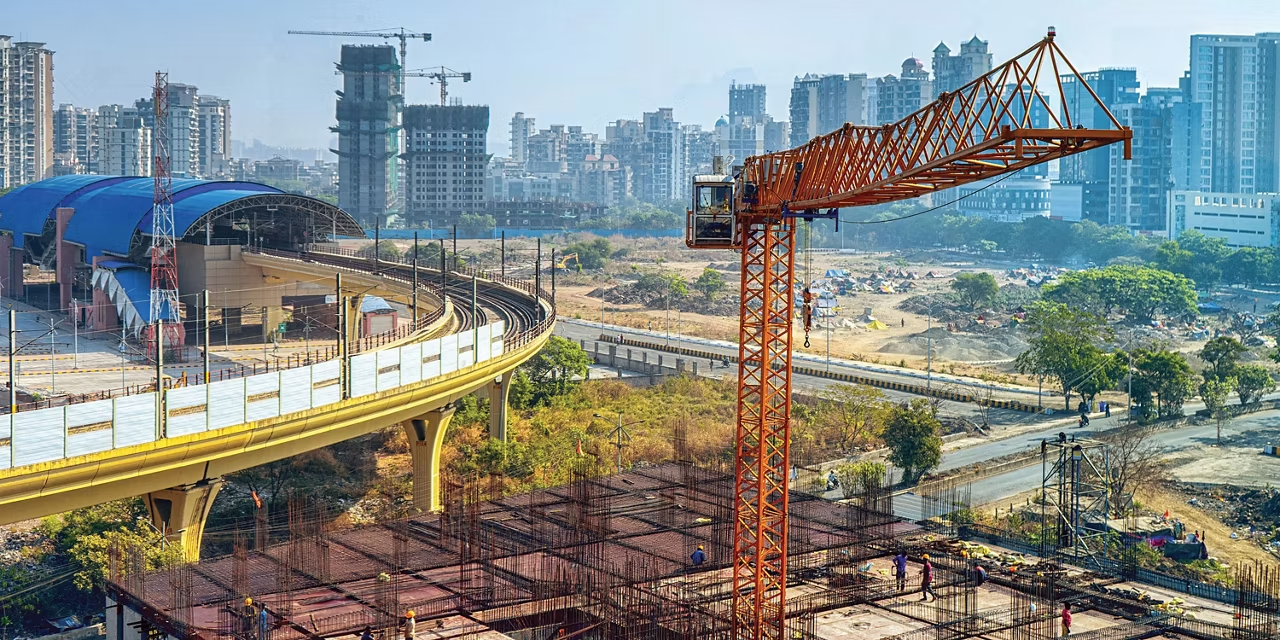
Retail Boom, Market Volatility, and Export Momentum Shape Today’s Business Landscape
India’s business and commerce ecosystem is navigating a dynamic phase marked by strong retail-led consumption, volatile financial markets, and improving trade fundamentals. While global investors face uncertainty in Western economies and technology markets, India continues to emerge as a preferred destination for long-term capital—particularly in retail infrastructure, digital commerce, exports, and logistics.
This convergence of consumption growth, cautious capital flows, and trade resilience is reshaping India’s economic narrative.
Retail and Consumption: India as a Global Growth Magnet
One of the most prominent trends shaping today’s business landscape is the surge in global investment interest in India’s retail sector. As shopping malls and brick-and-mortar retail struggle across the U.S. and parts of Europe, India’s consumption-driven growth story—backed by a young population, rapid urbanisation, and rising disposable incomes—has become increasingly compelling for global investors.
Organised retail, private labels, D2C brands, warehousing, logistics parks, and omni-channel commerce models are attracting private equity and institutional capital. Retailers are also benefiting from improved supply chains, better inventory management, and logistics efficiencies, which are helping boost margins and scalability.
This shift underlines India’s transition from a cost-efficient market to a demand-driven consumption economy, firmly positioning the country as a long-term growth engine in global commerce.
Markets and Capital Flows: Volatility Amid Opportunity
Indian equity markets are currently experiencing short-term volatility, influenced by global risk-off sentiment, concerns around elevated valuations in technology stocks, and uncertainty over global interest rate trajectories. Selective profit booking and cautious foreign institutional investor (FII) activity have kept benchmark indices largely range-bound.
Within this environment, technology and digital economy stocks have come under scrutiny. Global tech corrections and AI-related valuation concerns have created near-term pressure, prompting investors to focus more closely on balance-sheet strength, cash flows, and sustainable growth models rather than pure growth narratives.
At the same time, speculative activity in niche segments such as AI-linked and select small-cap stocks reflects continued appetite for high-growth themes. Overall, market behaviour points to a wait-and-watch approach, not a loss of confidence in India’s structural growth story.
Trade and Exports: A Quiet but Crucial Positive
On the external front, India’s narrowing trade deficit is providing a stabilising counterbalance to domestic market volatility. Strong merchandise exports—particularly to the U.S.—combined with easing import pressures have improved trade numbers and strengthened macroeconomic stability.
Equally important is the renewed focus on services exports, including IT services, fintech, professional services, logistics, and tourism. Policy support, along with state-level export promotion schemes, is helping Indian service exporters expand their global footprint.
Discussions around new trade agreements and potential FTAs further enhance India’s export competitiveness, reinforcing the country’s ambition to integrate deeper into global supply chains.
Infrastructure and Logistics: The Backbone of Growth
The expansion of organised retail and e-commerce is driving strong demand for warehousing, cold storage, logistics parks, and last-mile delivery infrastructure. Increased investment in supply-chain digitisation, automation, and multimodal logistics is improving efficiency across sectors—from retail to exports.
This infrastructure push not only supports domestic consumption but also strengthens India’s position as a reliable manufacturing and export hub.
Policy Signals and Reform Debate
Parallel to these trends, debates around capital gains tax reforms and investment-friendly policies highlight the government’s efforts to align India’s tax and regulatory framework with long-term capital formation goals. If implemented effectively, such reforms could further enhance investor confidence, encourage patient capital, and support sustainable economic growth.
Popular posts

India's Talent behind the JIO 5G roll ou...
 The BharatBiz
20 Apr, 2024
The BharatBiz
20 Apr, 2024
 16
5203
16
5203

How to calculate GDP of a Country
The BharatBiz
02 Oct, 2023
16
5537
Positive Impact Of Demoniterization
The BharatBiz
04 Sep, 2023
16
5207